The Mind-Body Connection in Pole: What Pilates-Style Conditioning Actually Delivers (That Pilates Alone Can't)
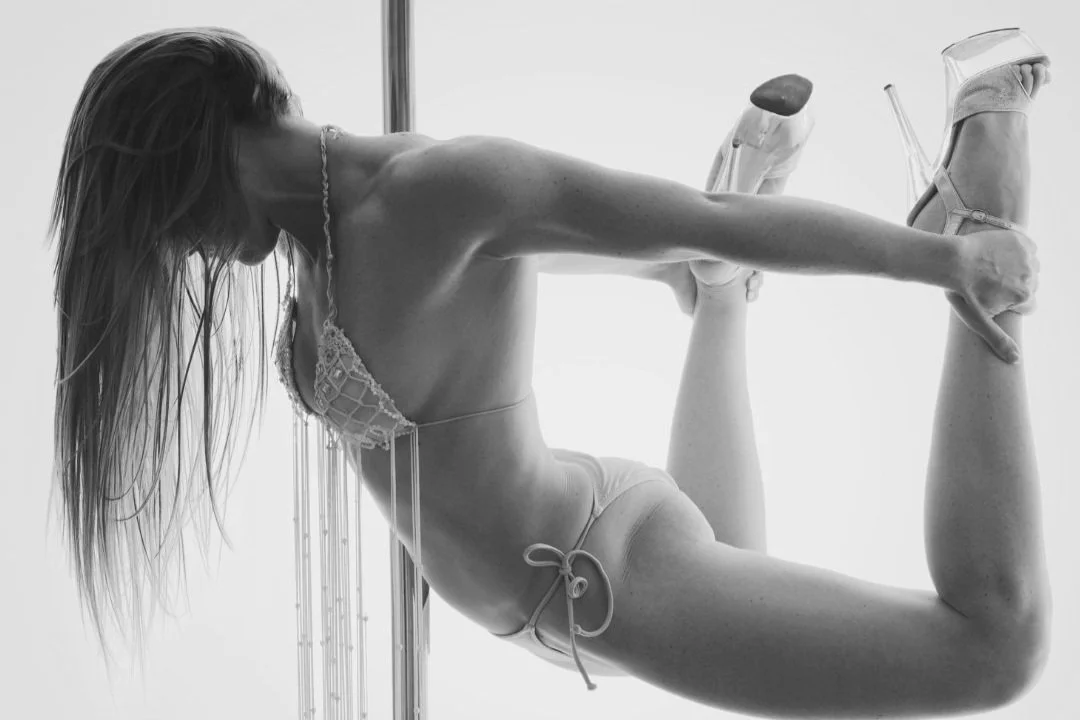
If you've been doing Pilates for years and still feel like something is missing — you're not imagining it.Pilates is a beautiful practice. It builds core awareness, teaches spinal articulation, improves posture, and develops a quality of movement that most fitness formats never touch. I respect it deeply. I incorporate its principles into everything I do at PoleBait Haus.But here's what Pilates wasn't designed to do: make you hold your entire bodyweight upside down on a vertical pole.And that distinction — that specific, thrilling demand — is exactly why the women who train with me experience a kind of physical transformation that years of Pilates, yoga, or barre simply didn't unlock for them.What Pilates Gets Right (And Where It Stops)
Pilates principles are foundational to how I train clients at PoleBait Haus. Breath, engagement, spinal articulation, intentional movement — these aren't just Pilates concepts. They're the building blocks of any intelligent, body-aware training methodology.
Where Pilates excels:Deep core activation and stabilitySpinal mobility and articulationBody awareness and proprioceptionInjury prevention and movement refinementMind-body connection through controlled, methodical work
But here's the honest limitation: Pilates, by design, does not provide progressive overload in the way your body needs to build real functional strength.Research published in the pole performance space is clear on this: Pilates reformer machines use spring-loaded tension that reduces force at peak effort — meaning the resistance actually lightens when you need it most. You can't track or gradually increase true load the way strength training demands. The result is a practice that refines and protects, but doesn't fundamentally build the muscular capacity required for demanding movement goals.A 2024 peer-reviewed feasibility study found that eight weeks of pole dancing classes produced significant improvements in muscular strength, cardiorespiratory fitness, body image, and physical self-concept — with measurable increases in lean mass in the upper body, specifically the arms and trunk. Eight weeks. These are the results that a decade of Pilates classes often can't replicate, not because Pilates is inferior — but because it's not asking your body to do the same thing.What the Pole Actually Demands
The pole is unforgiving in the best possible way. It doesn't let you cheat.When you grip a vertical pole and begin to ask your body to move around, above, and against it, your entire neuromuscular system has to show up. There's no spring tension lowering the resistance. There's no machine stabilizing your movement pattern. There's just you, the pole, and gravity.What pole training specifically develops:1. Grip strength — In gerontology research, grip strength is one of the most reliable biomarkers of biological aging and a predictor of overall mortality. On the pole, you develop it just by holding on. Every session.2. Upper body pulling strength — The lats, rhomboids, biceps, and rear deltoids do work in Pilates, but they are the primary movers in pole. Competitive female pole dancers have been shown in research to have significantly greater upper body muscle mass than untrained women — not from lifting in a gym, but from the repeated demand of manipulating their bodyweight on a vertical apparatus.3. 3D spatial awareness and neuroplasticity — Studies show that dancing protects the brain from aging better than monotonous cardio. Pole takes this further. You move in all planes simultaneously, often upside down, which forces your brain to build and rewire neural connections constantly.4. Core stability under load — Not the controlled, supported core engagement of a reformer class, but functional core strength that holds your body rigid when you're horizontal, inverted, or hanging by one hand.How Polebait Trains Differently
This is where the Fluid Body Method™ diverges from both traditional pole and traditional Pilates.I take the philosophy of Pilates — breath first, engagement before movement, methodical progression, training toward specific goals — and I apply it to the physical demands of pole. The result is a training approach that's both intelligent and transformative.Here's what that looks like in practice:When a client comes to me with the goal of learning an Ayesha, a freestanding handstand-like hold on the pole requiring exceptional shoulder, core, and lat strength, I don't just put her on the pole and tell her to try. I build her from the ground up, off the pole, for as long as it takes.She'll do upper body conditioning specifically designed to develop the pulling strength, shoulder stability, and core compression needed to support that move safely. We'll work breath and engagement patterns. We'll train her nervous system to trust her strength before we ask it to perform.And then, often months or even a year or more later, something shifts. The move that felt impossible starts to click. Not because she suddenly got stronger overnight — but because every session of intentional, goal-based conditioning has been adding up underneath the surface.That's not a Pilates outcome. That's not a generic pole class outcome. That's what happens when you train with a method.The Results Women Don't Expect
The most common thing I hear from women who've been training with me for six months or more isn't about a specific move they learned. It's a sentence that sounds something like this:"I didn't realize how much was building until it all came together."
Pilates gives women body awareness. Pole — practiced intentionally, with a methodology behind it — gives women body capability. The difference is felt, not just seen.Women who train in the Fluid Body Method report:Upper body and grip strength they've never had before — even after years of other trainingA relationship with their body that feels earned, not performedPhysical goals they'd stopped believing were possible for themJoy in training — which, research increasingly confirms, is one of the most powerful drivers of long-term fitness adherence
That last point matters more than it sounds. Women aren't just prioritizing results anymore. They're prioritizing joy in how they get there. And a practice that gives you the thrill of nailing something genuinely difficult — something your body built toward — creates a kind of intrinsic motivation that no reformer class has ever replicated.Who This Is For
If you've been doing Pilates or barre for years and love it, this isn't a replacement. It's what's next.If you've tried pole before and felt like it was all tricks or choreography and no method — what you experienced wasn't the Fluid Body Method.If you want to feel genuinely strong in a way that surprises you — in a space that's small, intentional, and built for women who take their bodies seriously — PoleBait Haus is where that happens.We train with the precision of Pilates and the demands of pole. The outcome is something neither delivers alone.Ready to start?
Flow Foundations is your entry point. It's a small-group session designed to introduce you to grip, breath, engagement, and the foundational movement pathways of the Fluid Body Method™. No experience necessary. Just curiosity and a willingness to feel what your body is actually capable of.
PoleBait Haus is a private pole and wellness studio in Los Angeles offering somatic pole training, goal-based conditioning, and the Fluid Body Method™ — a mind-body movement practice for women who want real strength, real results, and real joy in how they move.