Why Pole Dancing Is Actually a Somatic Practice (Not Just a Fitness Trend)
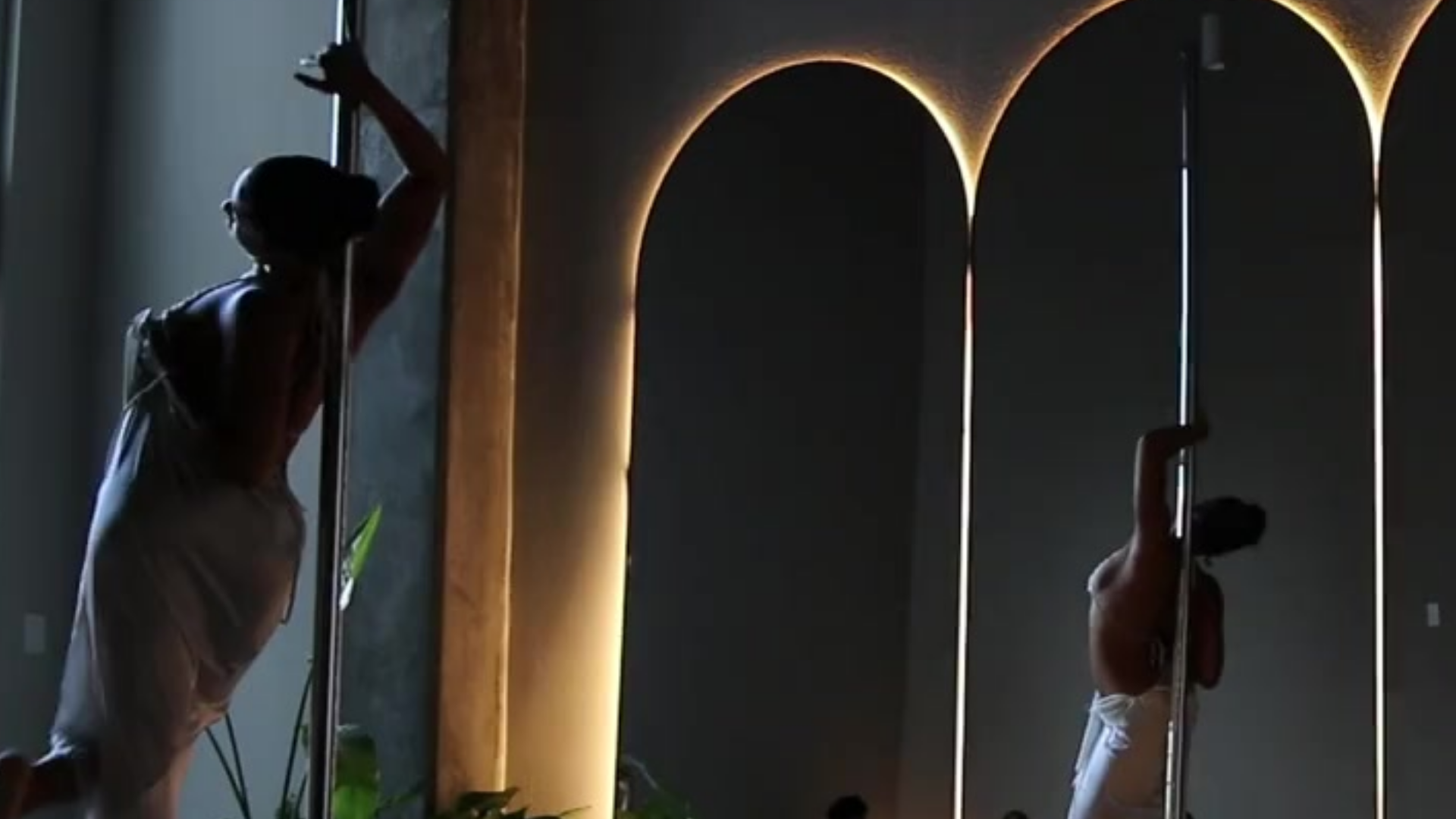
If you're someone who goes to therapy, practices breathwork, reads about the nervous system, or has ever said the words "I'm trying to get back into my body" — this post is for you.You probably haven't considered pole dancing.And I want to tell you why that might be the most important gap in your wellness practice.What "Somatic" Actually Means
The word somatic comes from the Greek soma — meaning body. At its core, somatic practice is any approach that cultivates awareness of your internal physical experience: sensation, breath, tension, movement impulse, and the body's response to emotion and environment.
Research defines it precisely as the awareness of internal bodily sensations — what scientists call interoception — and the capacity to use that awareness to regulate your nervous system, process stored stress, and reconnect with your lived experience from the inside out.Somatic practices are having a cultural moment right now, and for good reason. A 2025 study found that mindfulness-based movement and body awareness practices worked just as well as cognitive behavioral therapy for people with chronic pain — and the benefits lasted for a full year after the program ended. Researchers and therapists are increasingly recognizing that healing doesn't only happen through language and analysis. Sometimes the body needs to move through something rather than think through it.Yoga is somatic. Certain forms of dance therapy are somatic. Breathwork is somatic.And pole — practiced with intention, with presence, with a method behind it — is deeply somatic.Most people just don't know it yet.The Problem With How We Talk About Pole
The conversation around pole dance has been dominated by two frames: performance and fitness.
In the performance frame, pole is about what your body looks like doing something. In the fitness frame, pole is about what your body can physically do.Both of these frames keep the attention outside the body — on output, on achievement, on how it appears to others.Neither asks: what are you feeling right now, in this moment, as you move?That's the question somatic practice is built on. And it's the question I've been asking inside the Fluid Body Method™ since the very beginning.
How I Discovered Pole as Somatic Work
My entry point wasn't academic. It was experiential.
I trained for a time at a part-time drama school, where movement classes were central to the work — not as exercise, but as a tool for accessing character, emotion, and interior life. What I kept noticing was that movement and sound could reach something that verbal explanation simply couldn't. You could analyze a feeling intellectually for hours. Or you could move through it in five minutes and know it in your body in a way that stayed.When I began working with my first Fluid Body Series participants, I started testing those insights with pole as the medium. These women were coming to fill the space between their tricks — to find something deeper in the practice they already had. And what I discovered was that the pole, of all things, was an extraordinary container for somatic exploration.Not because of what it demands physically — though it demands a great deal — but because of what it requires internally. To move well on the pole, you cannot be disconnected. The pole will tell on you immediately.What Bringing the Body Online Actually Looks Like
In somatic practice, there's a phrase: bringing the body online. It means creating the conditions for a person to arrive fully in their physical experience — present, receptive, and ready to notice sensation rather than perform movement.
In the Fluid Body Method™, we do this through intentional warm-up with movement prompts rather than standard exercise sequences. The goal isn't just to heat up the muscles. It's to wake up the awareness.Some of the prompts I use:
Mute one limb.
Choose the limb you typically initiate movement with, and for the first few minutes, move as though it doesn't exist. What shifts? Where does the initiation have to come from instead? What do you notice about how you habitually organize yourself?Embody a weather element.
You are wind. You are the stillness before a storm. How does that quality live in your body? Where does it start? What does it do to your breath, your pace, your relationship with the space around you?Are you river, or are you ocean?
This one comes from a poem that moved me — about a river afraid of reaching the ocean, not knowing that becoming the ocean doesn't mean losing itself, but expanding into something larger. I ask participants: are you river today — in momentum, building, on your way — or are you ocean — expansive, already arrived, feeling the fullness of what you've become? That question changes how someone moves. Every time.
These prompts aren't warm-ups in the conventional sense. They're invitations to arrive. And what happens in the body after that kind of arrival is different from what happens when you just stretch and jump in.Why Pole Is Uniquely Suited for This Work
Somatic movement therapy works through awareness. When you slow down enough to notice sensation — subtle shifts in breath, tension, or movement — you begin to access patterns that are often outside of conscious control.Pole dancing accelerates this process in a specific way. Here's why:
It removes the buffer of the floor.
Most somatic movement happens horizontally — on a mat, in a chair, lying down. The pole asks you to organize your body vertically, against gravity, in three-dimensional space. Your nervous system has to work harder to find itself. That effort, when witnessed with awareness rather than force, becomes information.It demands grip.
The act of gripping something — really gripping it, trusting your hands to hold you — activates the nervous system in a way that passively lying on a mat cannot. There is a primal quality to holding on. To trusting your own hands to keep you safe.It creates honest feedback.
You cannot perform presence on a pole. Tension reads. Disconnection reads. The body that is holding its breath moves differently from the body that is breathing. The pole becomes a kind of mirror — not for how you look, but for where you actually are.It gives sensation a destination.
One of the challenges of purely internal somatic work is that sensation can feel diffuse, unmoored. The pole gives it somewhere to go. Feeling becomes movement. Movement becomes expression. Expression becomes integration.The Shift That Happens
In the @uliana.exo carousel that's been circulating in the pole community lately, the biologist and pole artist writes about how dance broke the wall between her mind and her body — and that once that connection is restored, how you perceive the world changes forever. I've watched this happen inside my studio. I've felt it in my own body.Women come in describing disconnection, numbness, the sense of being a stranger in their own skin. They come in from years of high performance — in their careers, their relationships, their previous fitness practices — and they are exhausted from living entirely from the neck up.What pole offers, practiced somatically, is a way back down.Not by forcing anything. Not by performing healing. But by giving the body something interesting to do — something genuinely demanding and beautiful — and then paying attention to what it feels while it does it.The body stores memories of experiences, even if the mind doesn't fully recall them. Somatic approaches help release these stored patterns and restore emotional balance by working directly with the body through movement, breath, and sensation awareness.Pole, at its best, is exactly that kind of work.For the Women Already in the Pole World
If you've been training for a while and something still feels missing — if you've got the tricks but not the presence, the strength but not the sensation — what you might be looking for isn't a harder move. It might be a softer question.What does this feel like? Not how does it look. Not am I doing it right. But what is actually happening in my body right now, in this moment, as I move?That question is the beginning of somatic pole practice. And once you start asking it, you can't really stop.Where to Begin
If you're new to pole and drawn to this way of working, Flow Foundations is where we start at PoleBait Haus. It's a small-group entry session built around breath, engagement, and foundational movement. But, the real work is in learning to feel what you're doing, not just do it.If you're a mover or pole dancer looking to go deeper, the Fluid Body Series is our progressive small-group program where the somatic work lives most fully.The pole is the tool. The work is you.
PoleBait Haus is a private pole and wellness studio in Los Angeles offering somatic pole training through the Fluid Body Method™. We work with women who are ready to stop performing movement and start inhabiting it.